






Unwanted,
uncontrolled oscillations in thermoacoustic systems like rocket and gas
turbine engines can not only reduce the lifetimes of such systems, but
can also even lead to structural damage and complete failure. These
thermoacoustic instabilities, which arise when heat release rate
fluctuations come into phase with pressure waves, can be suppressed or
eliminated by inducing the phenomenon of amplitude death (AD). One way
of inciting the behavior is to couple individual oscillators in
differing ways.
A team of researchers reports in Chaos
on the effects of symmetric and asymmetric coupling on a thermoacoustic
system, demonstrating theoretically that AD can be achieved under both
coupling modes. Their mathematical model consists of two horizontal
Rijke tubes, which create high-amplitude acoustic pressure oscillations
with the application of heat. With this, the team investigated the
effects of time-delay and dissipative coupling applied both separately
and simultaneously.
Most work on
thermoacoustic oscillations to date has focused on passive suppression
in isolated systems, and may have only limited applicability for
practical thermoacoustic systems. This new work is the first systematic
investigation of suppression in coupled systems.
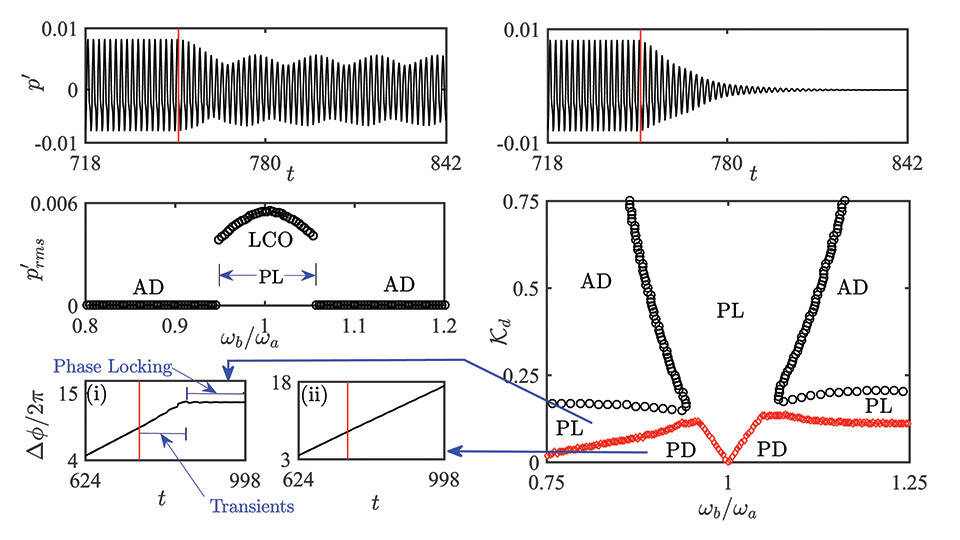
The
authors applied each form of coupling — time-delay and dissipative — to
the two Rijke tubes separately and then simultaneously. AD was easiest
to achieve with both forms applied simultaneously, but was also
attainable under asymmetric coupling and when the coupled oscillators
displayed dissimilar amplitudes. Even when the coupling is not strong
enough to achieve AD, both oscillators displayed significantly reduced
amplitudes.
The researchers note that if
these results can be verified in an experimental thermoacoustic model,
they may point the way toward new applications for the use of AD in the
suppression and control of damaging oscillations in practical systems.
Source:
“Effect of time-delay and dissipative coupling on amplitude death in
coupled thermoacoustic oscillators,” by Nevin Thomas, Sirshendu Mondal,
Samadhan A. Pawar, and R. I. Sujith, Chaos (2018). The article can be accessed at https://doi.org/10.1063/1.5009999.
Please Note: The number of views
represents the full text views from December 2016 to date. Article
views prior to December 2016 are not included.

