
When an aircraft enters a spin—a motion wherein a stalled aircraft spirals downward—predicting its behavior becomes extraordinarily challenging. The aerodynamics are nonlinear and unsteady, and depend not only on what’s happening now but also on what happened moments before. Traditionally, researchers used extensive wind tunnel testing to build aerodynamic models for aircraft spin. These models are significantly more complex than the aerodynamic models required to predict flight during, for example, cruise or turn. Furthermore, this approach is time-consuming and expensive, often yielding models with limited fidelity.
Data-driven modeling offers a promising alternative, with techniques such as Dynamic Mode Decomposition (DMD) leading the way. However, these methods do not directly apply to real flight data, wherein the measurements of outputs as well as inputs (such as elevator deflection) are noisy. Also, the sensors used in aircraft have vastly different noise characteristics. Standard DMD methods fail to produce correct and reliable models in such cases. That’s exactly the problem my PhD student, Balakumaran, tackled in his research on robust aircraft spin modeling using enhanced Hankel Dynamic Mode Decomposition with error compensation—the results of which are published in the Aerospace journal.
Dynamic Mode Decomposition to Model Spin
Dynamic Mode Decomposition is a recent, popular data-driven technique. The fundamental idea behind DMD is rooted in Koopman theory. Koopman theory suggests that even if a system’s behavior appears completely nonlinear—such as smoke swirling—there exist special functions of the system’s state, called observables, whose evolution is perfectly linear in time under the action of the Koopman operator. By combining an infinite number of these observables, one can, in principle, reconstruct the original dynamics of the system.
DMD provides a practical, finite-dimensional approximation of this theory, offering a simple and predictive numerical model for the system’s dynamics. DMDc (Dynamic Mode Decomposition with Control) extends this approach to systems with control inputs, such as elevator/aileron/rudder deflections.
However, DMD and DMDc struggle when faced with strongly nonlinear systems for which only limited measurements are available—precisely the situation we encounter with aircraft spin data from typical sensor suites.
Adding Memory: The Hankel DMD Solution
Hankel DMD (HDMD) addresses this limitation by creating new measurements through the stacking of time-delayed copies of the original limited measurements. This is like building a “memory” of recent history. It is a bit like trying to understand a conversation by hearing the last several sentences rather than just the current word—the additional context dramatically improves comprehension.
Beyond intuition, there is a substantial mathematical backing for stacking up time-delayed measurements—it implicitly reconstructs state information that is unavailable in the original measurements, as justified by Takens’ embedding theorem. The Hankel DMD approach proves necessary for capturing aircraft spin dynamics with quasi-repetitive rotational patterns and unsteady aerodynamic lags.
The Real-World Obstacle: Errors in Variables
While Hankel DMDc provides the theoretical framework to model spin dynamics, real flight data presents a major practical hurdle: the Errors-in-Variables (EIV) problem.
Standard system identification assumes that only output measurements (rotation rates, accelerations, etc.) are noisy, while inputs (control surface deflections) are known precisely. This assumption underlies standard regression and model-fitting approaches. In real flight measurements, however, input measurements are also noisy.
The situation becomes even worse because different sensors have different noise characteristics. Rate gyroscopes measuring angular velocities have different noise properties than accelerometers measuring linear accelerations, which differ from potentiometers measuring control surface deflection angles.
Standard DMDc considers no measurement noise – neither in the outputs nor in the control inputs. Applying the standard DMDc technique to real flight data will produce models predicting biased estimates.
Our Solution: Hankel DMDc with Error Compensation
Balakumaran developed a new methodology that directly integrates the error-in-variables approach—compensating for noise in outputs and inputs, as well as different noise levels in various measurement channels—into the Hankel DMDc framework. He explored two strategies:
Total Least Squares (TLS): Unlike the ordinary least squares approach used in standard DMD, TLS addresses the fact that the regressor (input) also contains noise. It finds the best-fit model assuming noise in both input and output. However, equal noise is assumed in all measurements.
Bias Eliminating Least Squares (BELS): This is one of the standard techniques among EIV approaches, providing mathematically unbiased parameter estimates even when dealing with measurements from different sensors that have vastly different noise characteristics.
The challenge was to incorporate these techniques into the Hankel DMDc framework, a significant contribution of Balakumaran’s work.
Validation: From Theory to Flight
We validated our enhanced Hankel DMDc approach across three progressively complex scenarios:
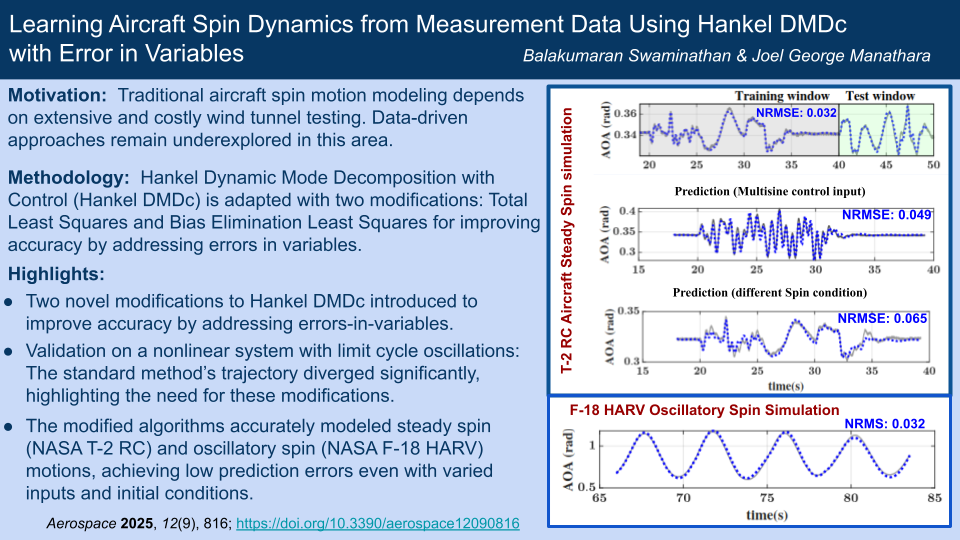
Simple nonlinear system: The efficacy of the proposed approach was first demonstrated on a dynamical system with control exhibiting limit cycle oscillations.
Steady aircraft spin: Next, using NASA’s T-2 aircraft simulation data, we demonstrated that our models could accurately reconstruct steady spin trajectories and predict responses to various control inputs, even when the control applied differed between training and testing conditions.
Oscillatory aircraft spin: Finally, we applied the method to NASA F-18 HARV oscillatory spin data, successfully capturing the complex, time-varying spin dynamics that could not be achieved via traditional DMDc.
The full technical details and validation results are available in our published paper for readers interested in the mathematical description and implementation specifics.
Impact and Implications
Aircraft spin represents one of the most critical and difficult flight conditions. Models that accurately predict spin can be used to devise effective spin recovery procedures, develop improved flight simulators for pilot training, and gain valuable design insights into how aircraft modifications impact spin characteristics. Aircraft spin models built using our data-driven modeling framework will aid in these.
In this work, we demonstrated how addressing the errors-in-variables problem unlocks the full potential of DMD-based techniques, leading to improved models. In the broader sense, this work demonstrates how existing noise handling approaches can be integrated with data-driven modeling techniques to produce unbiased and reliable system models. The work highlights the importance of meticulous accounting for real-world conditions to ensure the effectiveness of state-of-the-art data-driven methodologies.
Here is a graphical abstract of our work:
Related publication
- Swaminathan, B. & Manathara, J.G., Learning aircraft spin dynamics from measurement data using Hankel DMDc with error in variables, Aerospace, 12(9), 816, September 2025. doi:10.3390/aerospace12090816