Whether it’s military reconnaissance or wedding photography, using quadrotors (also known as multirotors) has become the standard. However, one of the primary limitations of today’s electric motor multirotors is their limited endurance, which is primarily due to battery capacity.
Using internal combustion (IC) engines would be much more efficient. While gasoline offers more than 25 times the energy density of lithium-polymer batteries, IC engines respond sluggishly compared to electric motors. Anyone who has driven a car with an IC engine knows the lag between pressing the accelerator and feeling the engine respond—a delay that would be catastrophic for a quadrotor trying to maintain stable flight.
Quadrotors are inherently unstable flying machines. They stay airborne and level only because their electric motors can change speed in milliseconds, constantly adjusting thrust to maintain balance. Owing to delays in carburetors, fuel-air mixing, and combustion cycles, an IC engine seems fundamentally incompatible with the rapid response required to stabilize an IC engine-powered quadrotor.
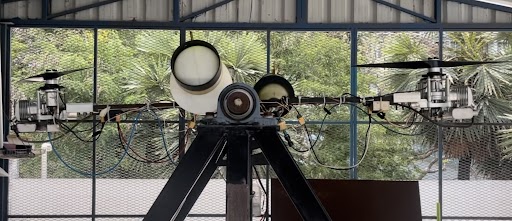 IC engine-based bi-rotor on a test stand
Equipping IC engines for quadrotor control is akin to transforming a marathon runner into a 100-meter sprint champion. That’s the engineering challenge Ajith, a PhD student whom I am co-guiding with Prof. Ramakrishna, tackled in his research, the results of which are published in an article titled “Throttle-controlled internal combustion engines as propulsion and control units for high endurance quadrotors: a feasibility study,” recently published in Aerospace Science and Technology.
0
Read full post
When an aircraft enters a spin—a motion wherein a stalled aircraft spirals downward—predicting its behavior becomes extraordinarily challenging. The aerodynamics are nonlinear and unsteady, and depend not only on what’s happening now but also on what happened moments before. Traditionally, researchers used extensive wind tunnel testing to build aerodynamic models for aircraft spin. These models are significantly more complex than the aerodynamic models required to predict flight during, for example, cruise or turn. Furthermore, this approach is time-consuming and expensive, often yielding models with limited fidelity.
Data-driven modeling offers a promising alternative, with techniques such as Dynamic Mode Decomposition (DMD) leading the way. However, these methods do not directly apply to real flight data, wherein the measurements of outputs as well as inputs (such as elevator deflection) are noisy. Also, the sensors used in aircraft have vastly different noise characteristics. Standard DMD methods fail to produce correct and reliable models in such cases. That’s exactly the problem my PhD student, Balakumaran, tackled in his research on robust aircraft spin modeling using enhanced Hankel Dynamic Mode Decomposition with error compensation—the results of which are published in the Aerospace journal.
0
Read full post
In August 2023, Chandrayaan-3’s Vikram lander touched down softly on the lunar surface, demonstrating its precise landing technology. As we continue to celebrate this triumph, it’s exciting to consider how emerging technologies might shape the future of landings - both in space and on Earth.
Whether it’s a lunar lander gracefully descending on the Moon’s surface, a Mars explorer touching down on the Red Planet, or a cutting-edge vertical takeoff and landing (VTOL) aircraft on Earth, the ability to land softly and safely is a complex yet crucial challenge.
Historically, liquid rocket engines have been the go-to for achieving VTOL capabilities in planetary vehicles, largely due to their ability to provide controllable thrust. However, VTOL applications on Earth necessitate a safer option. Enter hybrid rockets, which could prove to be a superior alternative for VTOL operations within Earth’s atmosphere and in space, offering advantages that extend well beyond just safety.
In another post, I had described my PhD student Anandu Bhadran’s work on establishing the thrust controllability of hybrid rocket motors. Leveraging on that, we embarked on a journey to show that hybrid rocket motors can be used for soft landings. Beyond simulations, we wanted to demonstrate soft landing using hybrid rocket motors. However, we did not have the bandwidth, in terms of time and resources, to develop a complete platform for this.
Hence, Anandu, along with Prof. Ramakrishna and I, delved into an innovative approach to this problem – we demonstrated the practical feasibility of using hybrid rocket thrusters in landing platforms with a technique called hardware-in-the-loop simulation (HILS). We reported our studies in the International Journal of Aeronautical and Space Sciences.
This work was featured as a Linkedin post and also appeared in news.
0
Read full post
Asteroids, those ancient wanderers of our solar system, have long captivated astronomers and space scientists. Of course, the asteroids hold the key to unravelling the mysteries of our cosmic origins. But beyond that, these celestial bodies present unique opportunities for space exploration, and they do have some rare elements we would like to mine and take.
When it comes to exploring asteroids, finding the right orbits for spacecraft is crucial. Periodic orbits around these celestial bodies are potential trajectories for space probes, mining facilities, and even deep space stations. A periodic orbit is a closed, repeating trajectory in the asteroid’s rotating reference frame – like satellite trajectories around Earth. A periodic orbit family is a group of related periodic orbits with similar characteristics, such as shape, but may differ in size.
While various periodic orbit families and their bifurcations around asteroids have been extensively studied, a specific type of bifurcation, known as period-multiplying bifurcations, has received less attention. In his research published in Aerospace, Rishi—my PhD student—focused on computing these elusive period-multiplying bifurcations of periodic orbit families around asteroids.
0
Read full post
Traditionally, microgravity research has been done in space stations or by dropping payloads from towers or balloons. These methods are great, but they can be expensive and have limited availability.
 In a previous post, I talked about Siddhardha’s thesis that multirotors can be turned into microgravity platforms.
In fact, he showed that every multirotor has the capability to be a microgravity platform.
Multirotor microgravity platforms provide scientists with an affordable way to conduct experiments under near weightlessness conditions.
But how do you choose the appropriate multirotor UAV for your microgravity experiment?
In a previous post, I talked about Siddhardha’s thesis that multirotors can be turned into microgravity platforms.
In fact, he showed that every multirotor has the capability to be a microgravity platform.
Multirotor microgravity platforms provide scientists with an affordable way to conduct experiments under near weightlessness conditions.
But how do you choose the appropriate multirotor UAV for your microgravity experiment?
In a recent work published in Microgravity Science and Technology, Siddhardha and I laid down a framework for assessing the microgravity-producing capabilities of a multirotor UAV.
Using our framework, you can estimate the g-time that a particular multirotor can provide while carrying the experimental setup of a specified weight.
0
Read full post